
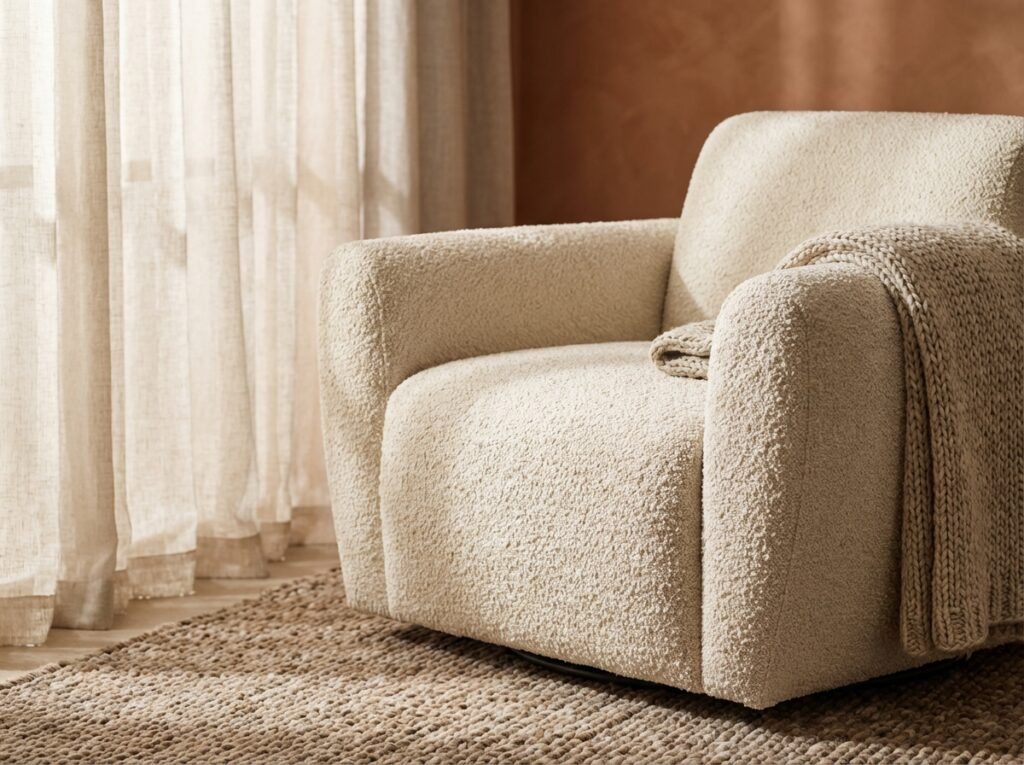
Run your palm across a bouclé armchair and feel how the looped surface catches at your fingertips, creating friction that demands attention. This sensation defines interior design in 2026, where touch has overtaken sight as the primary design language. Modenese Furniture, a premier Italian furniture firm recognized for its exceptional craftsmanship and distinctive portfolio, has positioned tactile materials at the center of its latest collections, understanding that contemporary luxury resides not in visual spectacle but in physical experience. The global textile market reached $1.99 trillion in 2026, driven by consumers who crave materials they can sink into, stroke, and wrap themselves within.
Three fabrics dominate this sensory revolution: bouclé, with its nubby loops; brushed suede, offering velvety resistance; and sherpa, providing plush insulation. Together, these materials create what designers call cocoon-like environments, spaces that embrace inhabitants through texture rather than aesthetics. The shift represents a fundamental recalibration in how humans interact with their homes, moving from spaces designed to impress visitors toward sanctuaries engineered for physical comfort.
Market Forces Driving Textile Transformation
The textile industry stands at $2.28 trillion in 2026, expanding at 7.35% annually through 2034. Natural fibers command 44.8% of market share, reflecting consumer migration toward materials that age gracefully rather than deteriorate. According to the U.S. Department of Commerce, shipments in the textile mills industry totaled $25.3 billion in 2023, employing 89,300 workers across 1,786 establishments. This industrial foundation supports the material innovations reshaping residential interiors.
Asia Pacific accounts for 54% of global textile production, yet North American manufacturers have carved out profitable niches in technical and performance fabrics. The U.S. Bureau of Labor Statistics tracks productivity gains in textile mills, where output per hour increases as manufacturers adopt automated weaving technologies while preserving the irregular textures consumers demand. The contradiction defines modern textile production: industrial efficiency deployed to create handcrafted irregularity.
| Biodegradability, comfort, and sustainability concerns | 2026 Value | Growth Rate (CAGR) | Key Drivers |
|---|---|---|---|
| Global Textile Market | $2.28 trillion | 7.35% | Natural fiber demand, home furnishing growth |
| Natural Fibers | 44.8% market share | Stable growth | Biodegradability, comfort, sustainability concerns |
| Technical Textiles | $481 billion by 2035 | 6.55% | Smart fabrics, sensor integration, performance applications |
| U.S. Textile Mills | $25.3 billion (2023) | Modest rebound | Government contracts, domestic innovation, reshoring |
Bouclé: The Architecture of Touch
Bouclé construction begins with yarn loops that refuse to lie flat. The French term translates as “curled” or “ringed,” describing how weft threads loop around warp threads to create a three-dimensional surface. In 2026, bouclé has evolved beyond its pandemic-era popularity into more complex iterations. Eyelash bouclé combines traditional loops with fine, fuzzy yarns that create visual movement as light shifts across the surface throughout the day.
The fabric performs exceptionally well in upholstery applications where durability meets sensory appeal. Performance versions now incorporate stain-resistant treatments without sacrificing the signature nubby texture. Manufacturers achieve this through molecular-level coatings that repel liquids while preserving the yarn’s ability to catch and reflect light. The result satisfies households with children or pets who previously avoided textured fabrics due to maintenance concerns.
Interior designers pair large-scale bouclé pieces with finer weaves to create textural depth. A chunky bouclé sofa gains sophistication when flanked by linen curtains and smooth leather ottomans. The interplay between coarse and smooth surfaces defines contemporary luxury, replacing the monolithic material schemes that dominated previous decades. Scale variation matters: oversized loops read as casual and inviting, while tightly packed loops convey refinement.
Bouclé Applications Across Living Spaces
- Upholstered furniture (sofas, armchairs, ottomans) providing focal points through texture rather than color
- Accent pillows and throws offering immediate tactile updates without full furniture replacement
- Wall panels and headboards create immersive surfaces that absorb sound and soften hard edges
- Dining chairs combining comfort with visual interest through varied loop sizes
- Floor coverings in low-traffic areas where plushness outweighs durability requirements
Brushed Suede: Resistance and Release
Brushed suede offers a different tactile proposition than bouclé’s three-dimensional texture. The napped surface provides directional friction, feeling smooth when stroked one way and resistant when stroked the other. This quality creates an interactive relationship between material and inhabitant, encouraging repeated touch. Manufacturers produce brushed suede through mechanical abrasion that raises fibers perpendicular to the base fabric, creating a uniform pile height measured in millimeters.
Microsuede variants dominate 2026 applications due to performance characteristics that natural suede cannot match. Tightly woven synthetic fibers resist staining while maintaining the characteristic velvety hand. Economic Research Service data show that cotton consumption by U.S. textile mills increased 3.5% year-over-year, yet synthetic performance fabrics are capturing growing market share in upholstery applications where maintenance concerns override natural fiber preferences.
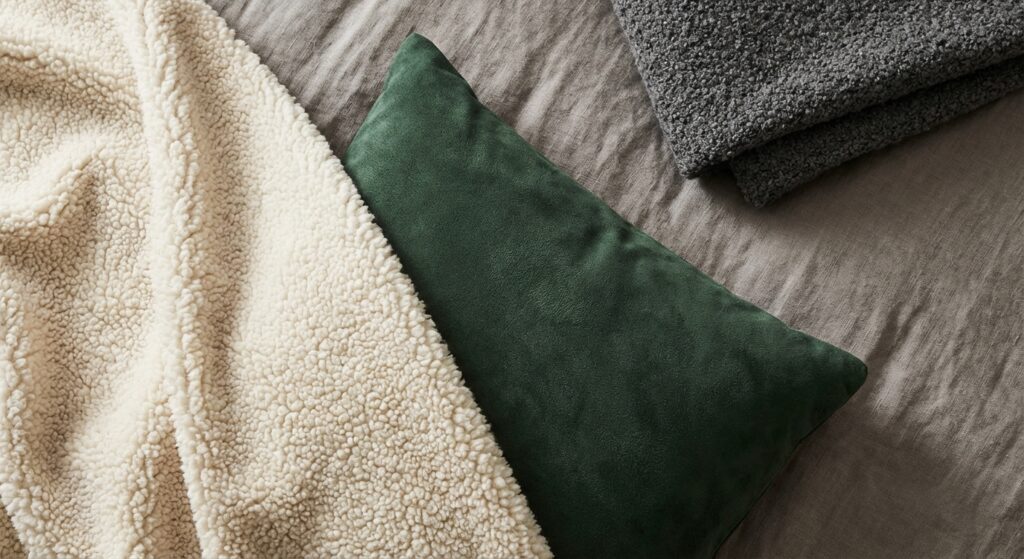
Color saturation in brushed suede surpasses most natural textiles, enabling deep jewel tones that absorb light rather than reflect it. Designers exploit this quality in cocoon-like spaces where walls, upholstery, and drapery share similar hues, creating enveloping atmospheres. The technique, called color drenching, uses suede’s light-absorbing properties to eliminate visual interruptions and focus attention on physical comfort.
| Fabric Type | Primary Sensory Quality | Maintenance Level | Ideal Applications |
|---|---|---|---|
| Bouclé (Natural) | Three-dimensional loops, variable texture | Moderate (professional cleaning recommended) | Statement furniture, accent pieces |
| Bouclé (Performance) | Looped texture with stain resistance | Low (wipeable surfaces) | Family rooms, pet-friendly spaces |
| Brushed Microsuede | Directional nap, velvety resistance | Low (machine washable in some forms) | High-traffic seating, children’s spaces |
| Natural Suede | Organic variation, patina development | High (specialist care required) | Investment pieces, low-contact applications |
| Sherpa Fleece | Deep pile, thermal insulation | Moderate (prone to matting with use) | Throws, accent pillows, seasonal layering |
| Sherpa Bonded Suede | Dual-surface (smooth exterior, plush interior) | Low to moderate | Blankets, outerwear-inspired interiors |
Sherpa: Engineering Warmth Through Texture
Sherpa fabric engineering mimics the natural look of sheepskin through manipulation of polyester fibers. Manufacturers create the characteristic curly pile by brushing synthetic fibers until they develop irregular clumps and swirls. The resulting texture traps air in thousands of tiny pockets, providing thermal insulation that rivals natural wool while maintaining wash-and-wear convenience. In bonded sherpa constructions, a smooth suede-like face adheres to the fluffy reverse, creating dual-surface functionality.
The fabric gained prominence in fashion during winter 2025-2026, with jacket linings and collar treatments popularizing the texture. Interior designers quickly adapted sherpa for residential applications, recognizing its potential to create cocooning effects through pure tactile immersion. Throws and blankets represent the most common deployment, but upholstered furniture featuring sherpa accents has emerged as a distinctive trend for those seeking maximal textural impact.
Sherpa performs best in applications requiring immediate tactile gratification. Unlike bouclé’s subtle loops or suede’s directional nap, sherpa announces itself through exaggerated plushness. This quality makes it suitable for accent applications rather than primary upholstery, where the texture might overwhelm through sheer sensory intensity. Designers layer sherpa with smoother materials to create contrast and prevent visual monotony.
Sherpa Integration Strategies
- Throws draped over neutral sofas, inviting inhabitants to reach for immediate comfort
- Accent pillows clustered in reading nooks, creating tactile focal points without dominating visual space
- Blanket ladders displaying Sherpa textiles as sculptural elements while maintaining accessibility
- Reversible designs pairing sherpa with contrasting smooth surfaces for seasonal versatility
- Limited upholstery applications on chair backs or seat cushions, providing texture without overwhelming
The Sensory Design Philosophy Reshaping Interiors
Touch-first design represents a philosophical shift in how professionals approach residential spaces. For decades, interior design prioritized visual composition, arranging rooms to photograph well rather than feel good. Pinterest-perfect aesthetics demanded pristine surfaces, minimal clutter, and coordinated color schemes. This approach produced beautiful but sterile environments that discouraged physical interaction.
The 2026 reversal stems from multiple converging factors. Extended time at home over the past few years made inhabitants acutely aware of how spaces shape daily experience. Increased screen time created hunger for tangible, analog experiences that provide sensory relief from digital immersion. Mental health awareness highlighted how physical environments influence emotional states, with research linking textured surfaces to stress reduction through tactile stimulation.
Designers now specify materials based on how they feel before considering how they look. This inverts traditional design hierarchies and produces interiors that privilege inhabitant experience over guest impression. The movement aligns with broader cultural shifts toward authenticity, sustainability, and wellness, rejecting aspirational perfection in favor of a livable reality.
Creating Cocoon Environments Through Material Layering
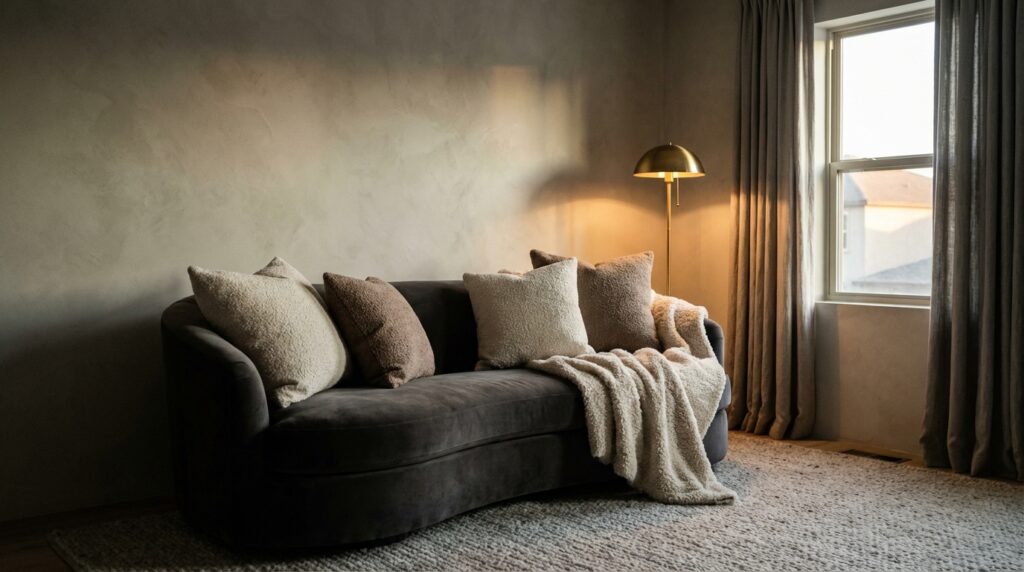
Cocoon-like spaces share specific characteristics regardless of aesthetic style. They employ multiple textural layers at different heights and scales. Floor treatments begin with plush area rugs that provide softness underfoot and absorb sound. Mid-level textures appear on upholstered furniture in three dominant fabrics: bouclé, brushed suede, and sherpa. Upper-level texture comes through window treatments in heavy linen or textured weaves that diffuse light while adding tactile interest.
Color saturation increases in cocoon spaces, with designers favoring deep, enveloping hues over bright whites. Mocha, terracotta, forest green, and warm charcoal create what psychologists call “psychological enclosure,” making rooms feel protective rather than expansive. These colors interact with textured surfaces to create dimensional effects as light shifts throughout the day. Shadows deepen in bouclé loops while sherpa catches and reflects warm tones.
Lighting design supports tactile environments through low, diffused sources rather than bright overhead illumination. Floor lamps, table lamps, and wall sconces, when positioned at eye level or below, create gentle pools of light that highlight texture through shadow and relief. This approach reveals the three-dimensional qualities of bouclé loops and suede naps that overhead lighting flattens.
| Design Element | Cocoon Strategy | Material Recommendations | Sensory Impact |
|---|---|---|---|
| Flooring | Layered rugs in high-traffic areas | Wool, thick cotton weaves, low-pile textured rugs | Softness underfoot, sound absorption, thermal comfort |
| Seating | Deep cushions, enveloping forms | Bouclé upholstery, brushed suede accents, supportive foam | Physical embrace, pressure relief, tactile engagement |
| Layering Pieces | Throws, pillows, blankets within reach | Sherpa fleece, chunky knits, quilted textiles | Immediate comfort access, temperature regulation, nest-building behavior |
| Window Treatments | Heavy, sound-dampening panels | Lined linen, textured weaves, layered curtains | Light diffusion, acoustic softening, privacy enhancement |
| Wall Surfaces | Matte, light-absorbing finishes | Limewash, clay plaster, fabric panels, upholstered headboards | Visual softness, sound absorption, touchable surfaces |
Performance Characteristics and Longevity Considerations
Tactile fabrics face unique maintenance challenges that influence long-term satisfaction. Bouclé loops can snag on jewelry, pet claws, or sharp objects, requiring immediate repair to prevent unraveling. Performance treatments mitigate this risk but cannot eliminate it entirely. Homeowners should understand that visible texture invites interaction, which can increase wear compared to smooth upholstery.
Brushed suede and microsuede require regular vacuuming to prevent dust accumulation in the nap. The directional pile can show wear patterns in high-contact areas, developing shiny patches where friction compresses fibers. Professional cleaning restores nap height and appearance, but repeated cleaning eventually degrades synthetic fibers. Natural suede develops a patina with use, which some owners value and others find objectionable.
Sherpa presents challenges with matting and pilling. The curly pile flattens in areas experiencing repeated pressure or friction. Regular fluffing and rotation extend appearance retention, but sherpa textiles eventually require replacement rather than restoration. Sherpa’s affordability makes periodic replacement economically feasible, allowing homeowners to refresh spaces with textural updates rather than complete furniture replacement.
Maintenance Requirements by Fabric Type
- Bouclé (natural fibers): Professional cleaning every 12-18 months, immediate snag repair, rotation of removable cushions to distribute wear
- Bouclé (performance treated): Spot cleaning with approved solutions, professional deep cleaning annually, gentle vacuuming with upholstery attachment
- Brushed microsuede: Weekly vacuuming to prevent dust buildup, professional cleaning every 24 months, periodic brushing to restore nap direction
- Natural suede: Specialist suede cleaning only, immediate stain treatment, protective sprays reapplied seasonally
- Sherpa fleece: Machine washing on gentle cycle for removable pieces, air drying to prevent heat damage, regular fluffing to maintain loft
- Sherpa bonded suede: Spot cleaning smooth side, gentle machine washing when possible, replacement planning every 2-3 years for high-use items
Economic and Environmental Implications
The tactile textile trend affects manufacturing and consumption patterns throughout the supply chain. Natural fiber demand has increased cotton prices and stimulated wool production, benefiting agricultural sectors in cotton-growing regions. USDA Economic Research Service reports track raw fiber equivalents of U.S. textile trade, showing how finished goods translate into agricultural commodity demand.
Sustainability concerns shape material selection as consumers balance tactile desires with environmental responsibility. Recycled polyester sherpa and bouclé, manufactured from reclaimed fibers, address waste reduction while delivering the desired textures. Brands including Kvadrat and Camira lead green innovations, producing high-performance textiles from post-consumer plastics and regenerated wool. These materials meet both tactile and ethical requirements, enabling consumers to indulge their sensory preferences without compromising their values.
Durability calculations reveal complex tradeoffs between initial cost, maintenance expenses, and replacement frequency. High-quality natural bouclé justifies premium pricing due to its decades-long lifespan when properly maintained. Affordable sherpa requires periodic replacement but enables frequent aesthetic updates at a manageable cost. Brushed microsuede occupies the middle ground, offering reasonable durability at moderate price points. Informed consumers match material choices to usage patterns and budget constraints rather than pursuing universal solutions.
Regional Variations and Cultural Adaptations
Tactile preferences vary by climate and cultural context, influencing how different regions adopt the three dominant fabrics. Cold-climate markets embrace sherpa and heavy bouclé for thermal benefits beyond aesthetic appeal. Warm-climate consumers favor lighter-weight brushed cotton and linen-blend textured fabrics that provide sensory interest without thermal burden. Manufacturers respond by engineering regional variants that maintain characteristic textures while adjusting fiber content and density.
European markets, particularly Scandinavia, pioneered hygge-inspired cocoon spaces that influenced global trends. The emphasis on physical comfort through textural layering originated in cultures that experience long, dark winters, where homes serve as primary gathering places. Southern hemisphere markets adapted these concepts to suit different seasonal patterns, deploying heavy textures during cooler months and storing them during summer rather than maintaining a year-round presence.
Asian markets demonstrate growing interest in tactile textiles as urbanization increases apartment living and reduces access to outdoor spaces. Compact interiors benefit from cocoon strategies that create psychological refuge despite physical constraints. Japanese manufacturers have developed space-efficient textural solutions, including modular bouclé panels and transformable sherpa cushions that serve multiple functions while maximizing sensory impact in minimal square footage.
Integration With Technology and Smart Home Systems
Tactile textiles operate independently of technological systems, yet designers increasingly combine physical comfort with digital convenience. Smart lighting systems coordinate with textured environments to highlight material qualities at different times of day. Circadian-programmed illumination shifts from bright, cool morning light to warm, dim evening tones that complement the cocooning effects of sherpa throws and bouclé upholstery.
Climate control integration enhances textural comfort by precisely managing temperature and humidity. Smart thermostats learn inhabitant preferences and adjust conditions to maintain optimal comfort for specific fabric types. Humidity sensors prevent natural fiber degradation while ensuring the sherpa maintains loft rather than becoming compressed through moisture exposure. These systems operate invisibly, supporting tactile environments without introducing technological intrusion.
Voice-controlled window treatments work in harmony with textured curtains and drapery, enabling occupants to adjust light levels without leaving their comfortable seating. Motorized systems eliminate the wear associated with manual operation, preserving textured fabrics longer. The integration provides technological support for analog comfort rather than replacement, prioritizing the physical experience over digital convenience.
Commercial Applications and Hospitality Trends
Hotels and restaurants have adopted cocoon strategies to differentiate guest experiences in competitive markets. Boutique properties emphasize tactile luxury through custom bouclé furniture and oversized sherpa throws encountered throughout public and private spaces. These materials signal investment in comfort while creating Instagram-worthy moments that serve marketing objectives without sacrificing genuine comfort.
Office environments embrace textured textiles as return-to-workplace initiatives prioritize employee experience. Lounge areas featuring bouclé seating and textured acoustic panels provide respite from screen-intensive work, supporting mental health and productivity. Facilities managers balance aesthetic goals with maintenance realities, specifying performance-treated fabrics that retain appearance even under heavy use.
Healthcare and senior living facilities recognize tactile stimulation’s therapeutic benefits and integrate textured materials into patient rooms and common areas. Brushed suede and soft sherpa provide sensory engagement for residents experiencing cognitive decline, while bouclé’s dimensional texture offers visual interest for those with limited mobility. These applications extend beyond residential design into institutional contexts where human comfort increasingly drives specification decisions.
Future Trajectory and Material Innovation
The textile industry invests heavily in next-generation tactile materials that enhance current fabrics’ desirable qualities while addressing limitations. Bio-engineered fibers promise bouclé-like textures from sustainable feedstocks, including mycelium, algae, and agricultural waste. Laboratory-grown materials eliminate the environmental impact of animal agriculture while replicating wool’s thermal properties and structural integrity.
Nanotechnology applications create stain-resistant surfaces at the molecular level, enabling natural fibers to match synthetic performance without chemical treatments. These innovations could resolve the tension between authentic materials and practical maintenance requirements. Smart textiles incorporating phase-change materials and temperature-regulating fibers represent another frontier, potentially creating fabrics that actively adjust to maintain optimal comfort rather than passively insulating.
Color-changing textiles responsive to light, temperature, or touch may eventually enable dynamic surfaces that shift appearance throughout the day. Such materials would combine the tactile qualities of bouclé, suede, and sherpa with visual variety currently requiring multiple fabric types. While these innovations remain largely experimental, the development pipeline suggests continued evolution in how textiles deliver sensory experiences.
Practical Implementation for Homeowners
Successful integration of tactile textiles requires strategic planning rather than wholesale replacement. Begin with high-impact accent pieces: a bouclé accent chair, a sherpa throw, or a brushed suede ottoman. These elements provide immediate sensory gratification while allowing gradual assessment of how textured materials perform in specific households. Observe maintenance requirements, wear patterns, and family responses before expanding textural presence.
Layer textures incrementally across multiple scales. Combine large-scale elements, such as upholstered furniture, with medium-scale items, including pillows and throws, and small-scale touches, such as textured pottery or woven baskets. This approach creates dimensional richness without overwhelming spaces or budgets. Remove one smooth element for each textured addition to maintain balance and prevent visual chaos.
Consider the room function when selecting fabric types. High-traffic family rooms benefit from performance-treated bouclé or microsuede that withstands daily use. Formal living areas accommodate delicate natural textiles that receive gentler treatment. Bedrooms excel as cocoon spaces featuring multiple sherpa layers and soft lighting that encourage relaxation. Match material durability to usage intensity rather than applying universal solutions.
Budget-Conscious Textural Updates
- Sherpa throws and accent pillows provide immediate impact at $30-80 per piece, requiring no installation or professional involvement
- Slipcovers in bouclé or brushed suede transform existing furniture for $200-600, avoiding full replacement costs
- Area rugs with textured surfaces update spaces for $300-1,000, depending on size, providing foundational comfort
- DIY upholstery projects using performance microsuede offer customization for $100-300 in materials plus labor
- Seasonal rotation between smooth summer textiles and cocooning winter layers maximizes investment without requiring duplicates
The transformation of residential interiors through tactile textiles goes beyond aesthetic fashion. It signals a fundamental reassessment of what homes provide beyond shelter and storage. In 2026, spaces succeed when they wrap inhabitants in physical comfort, offering refuge from digital overstimulation and external pressures. Bouclé, brushed suede, and sherpa deliver this experience through materials that demand touching, encouraging physical interaction with environments that increasingly exist to be felt rather than simply viewed. The market data confirms what human hands already know: texture has become the new luxury, and cocoon-like spaces offer the sensorial bliss that defines contemporary domestic life.