
High-net-worth individuals in Dubai face specific regulatory requirements when installing panic rooms in residential properties. The Security Industry Regulatory Agency (SIRA) mandates strict technical standards for safe room installations, covering surveillance systems, access control, emergency power, and environmental controls. Antonovich Design, recognized as the best interior design company in Dubai, integrates these compliance requirements into luxury home projects from initial planning through final inspection.
SIRA-compliant safe rooms require coordination between architectural, electrical, and security disciplines. Antonovich Design operates as a professional fitout company in Dubai with international awards and a portfolio demonstrating compliance expertise across multiple high-security residential projects. The regulatory framework addresses five primary systems: video surveillance infrastructure, biometric access protocols, backup power generation, ventilation engineering, and communication redundancy.
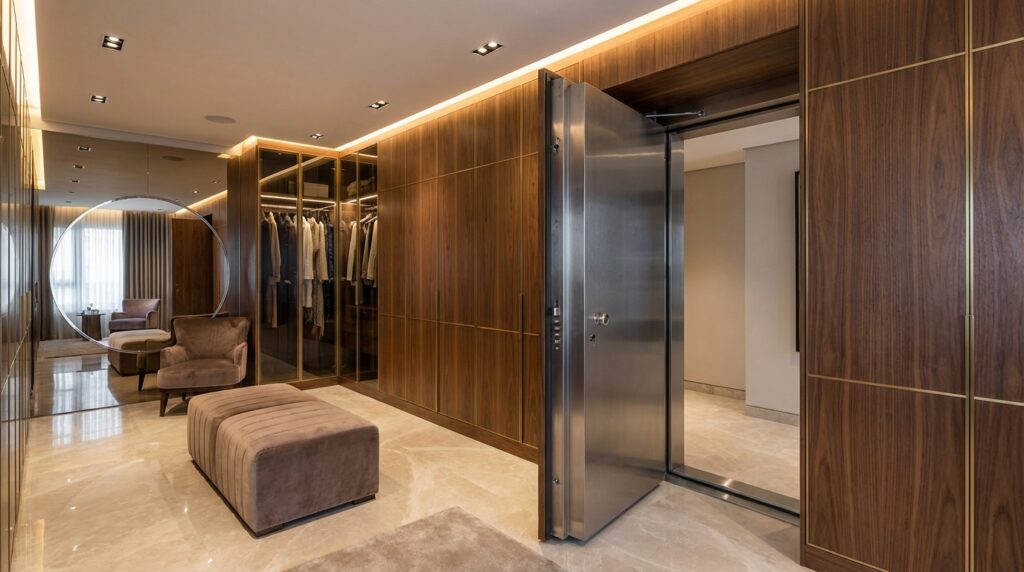
SIRA Registration and Permit Requirements
Safe room installations require advance approval through SIRA’s licensing system. Property owners must submit detailed technical drawings showing equipment locations, power distribution, and network architecture. The approval process takes 15-20 business days after complete documentation submission. SIRA issues a preliminary approval certificate, followed by site inspections at rough-in and final completion stages.
Contractors performing the installation must hold valid SIRA licenses in relevant categories: security systems installation (Category 1), CCTV systems (Category 2), and access control systems (Category 3). The Security Industry Regulatory Agency maintains current licensing requirements and fee schedules on their official portal. Non-compliant installations face immediate shutdown orders and financial penalties starting at AED 50,000.
CCTV Specifications and Coverage Standards
SIRA mandates a minimum 4MP resolution camera for all safe room surveillance systems. Cameras must support H.265 encoding and maintain 25 frames per second recording rates. The regulation specifies coverage requirements: no blind spots exceeding 0.5 square meters within the protected space, and camera placement ensuring facial recognition capability at all entry points.
| Specification | SIRA Minimum Requirement | Recommended Standard |
|---|---|---|
| Camera Resolution | 4MP (2560×1440) | 8MP (3840×2160) |
| Frame Rate | 25 fps | 30 fps |
| Recording Retention | 30 days | 90 days |
| Night Vision Range | 10 meters | 15 meters |
| Storage Redundancy | Local + Cloud | RAID 5 + Cloud |
Network video recorders (NVRs) must include failover capabilities with automatic switching to backup storage. SIRA requires encrypted data transmission using AES-256. Storage systems need physical security ratings that meet UL 2050 specifications for forced-entry resistance. The National Institute of Standards and Technology provides reference standards for encryption implementation that align with SIRA technical requirements.
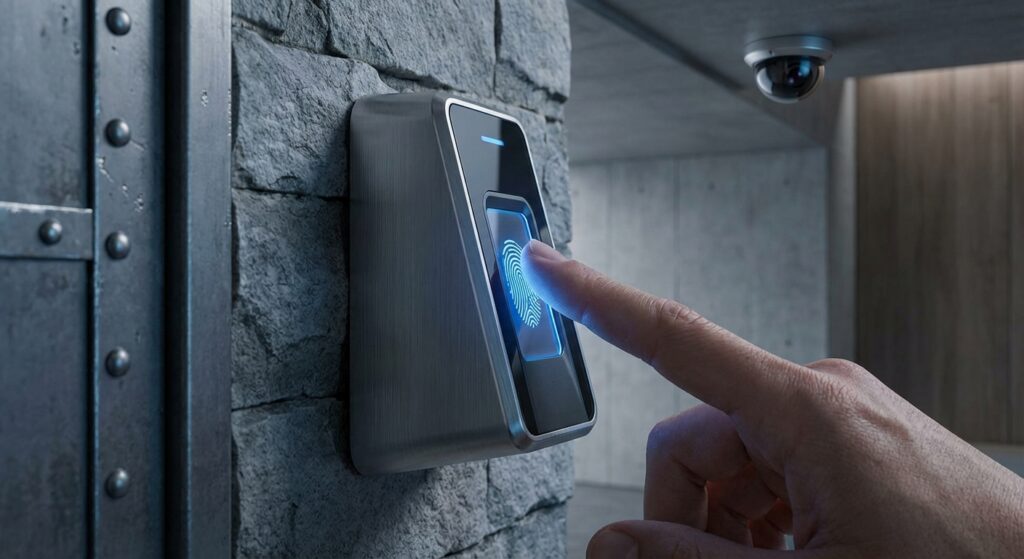
Biometric Access Control Implementation
Safe room access systems must incorporate multi-factor authentication, combining biometric verification with secondary authentication via PIN or proximity card. SIRA accepts fingerprint, iris, or facial biometrics that meet ISO/IEC 19794 standards. False acceptance rates cannot exceed 0.001% under laboratory conditions, and false rejection rates must be below 1% for enrolled users.
Access control panels require tamper-proof housing with accelerometer-based intrusion detection. The system logs all access attempts with timestamps, user identification, and the authentication method used. SIRA mandates 180-day log retention with encrypted backup to off-site servers within the UAE. Door hardware must achieve security grade 1 certification per ANSI/BHMA A156.30 standards, with forced entry resistance testing documented by accredited laboratories.
Biometric System Technical Checklist
- Fingerprint sensors: 500 DPI minimum resolution, live finger detection capability
- Iris scanners: 200mm capture distance, 2-second maximum authentication time
- Facial recognition: 3D mapping capability, anti-spoofing liveness detection
- Controller redundancy: Dual-processor architecture with automatic failover
- Battery backup: 72-hour operation capacity for the access control system
- Duress codes: Silent alarm integration with monitoring stations
- Anti-passback: Prevents credential sharing through entry/exit tracking
Independent Power Supply Configuration
SIRA requires safe rooms to maintain 72 hours of operational independence from the main building’s power. This necessitates dedicated generators or battery systems sized to support all security equipment, environmental controls, and communication systems simultaneously. Automatic transfer switches must engage within 10 seconds of primary power failure, with zero interruption to security monitoring functions.
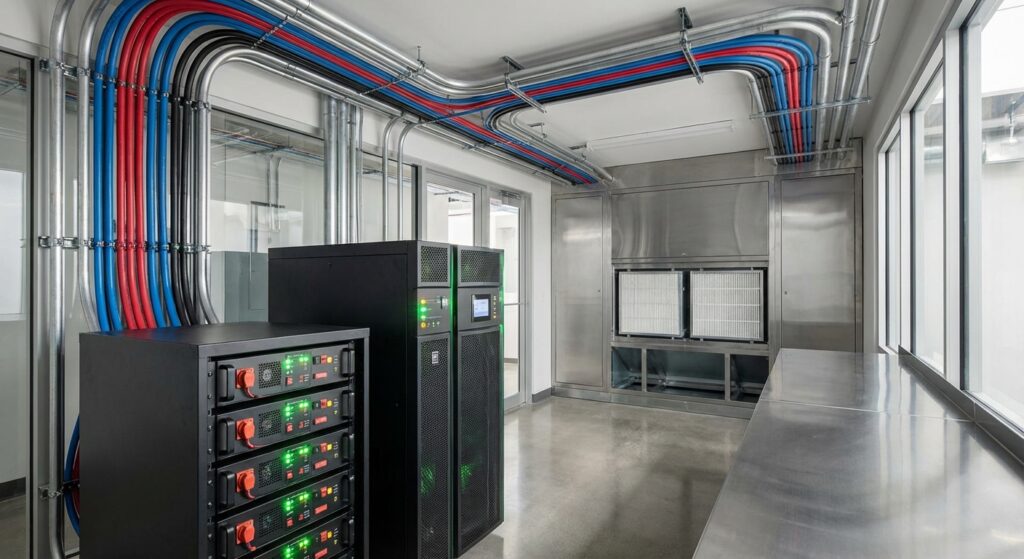
Generator installations must meet additional requirements: a minimum 20kW capacity for residential safe rooms under 50 square meters, fuel storage for 72-hour continuous operation at full load, and automatic weekly testing cycles with logged results. Battery systems require capacity testing every six months, with documentation submitted to SIRA. The U.S. Department of Energy publishes guidelines for backup power system sizing that inform SIRA capacity calculations.
| Power Load Category | Typical Draw | 72-Hour Capacity Required |
|---|---|---|
| CCTV System (4 cameras + NVR) | 150W | 10.8 kWh |
| Access Control | 50W | 3.6 kWh |
| Ventilation System | 800W | 57.6 kWh |
| Communication Equipment | 100W | 7.2 kWh |
| Lighting (LED) | 200W | 14.4 kWh |
| Total Base Load | 1,300W | 93.6 kWh minimum |
Uninterruptible power supply (UPS) units bridge the gap during generator startup, maintaining continuous operation of security systems. SIRA specifies a pure sine-wave output with voltage regulation within a 5% tolerance. Transfer switch testing occurs monthly with automatic logging to the building management system.
Ventilation and Environmental Control Standards
SIRA establishes minimum air exchange rates of 6 air changes per hour for occupied safe rooms, increasing to 12 air changes per hour if the space exceeds 30 square meters or accommodates more than four occupants. Ventilation systems must operate independently of the building HVAC infrastructure, drawing fresh air through dedicated intake points with NBC (nuclear, biological, chemical) filtration.
Air filtration requires HEPA filters rated H13 or higher per EN 1822 standards, capturing 99.95% of particles at 0.3 microns. Chemical filtration adds activated carbon beds rated for organic vapor removal and acid gas neutralization. The system includes CO2 monitoring with automatic ventilation rate adjustment, maintaining concentrations below 1000 ppm during occupancy.
Ventilation System Compliance Points
- Intake location: Minimum 3 meters above ground level, 10 meters from vehicle exhaust points
- Filter housing: Tool-free access panels for maintenance, filter change indicators
- Pressure maintenance: Positive 0.05 inches water column relative to adjacent spaces
- Temperature control: 18-24°C range with 2°C maximum deviation
- Humidity regulation: 30-60% relative humidity, preventing condensation
- Noise levels: Maximum 40 dBA during normal operation, 50 dBA in emergency mode
- Emergency override: Manual controls accessible from within the safe room
Ductwork must be fire-rated with a minimum 2-hour rating. Dampers include motorized controls allowing occupants to seal the space completely during chemical threat scenarios. The American Society of Heating, Refrigerating and Air-Conditioning Engineers provides technical standards for ventilation system design that complement SIRA requirements.
Communication System Requirements
SIRA mandates redundant communication pathways connecting safe rooms to emergency services and private security providers. Primary systems use landline connections, with cellular backup through multiple carriers and satellite communication as a tertiary backup. Each system requires independent power sources and automatic failover testing.
Video intercom systems must support two-way communication with door stations and security monitoring centers. The regulation requires a minimum video quality of 1080p and acoustic echo cancellation. Panic buttons trigger immediate alerts to registered monitoring stations with GPS coordinates and premises identification transmitted automatically.
Structural and Construction Standards
Safe room walls must meet UL 752 Level 4 standards at a minimum, stopping .44 Magnum rounds. Wall construction typically uses steel-reinforced concrete with a minimum thickness of 200 mm, or layered systems combining steel plate, Kevlar panels, and concrete board. Ceiling and floor assemblies match wall specifications to prevent penetration from above or below.
Door assemblies achieve security level 8 per EN 1627 standards, incorporating multi-point locking mechanisms with a minimum of 12 locking points. Frame anchoring uses through-bolts at 300mm spacing into structural elements. Hinges employ anti-lift pins and concealed mounting, preventing removal from the exterior. The Consumer Product Safety Commission establishes glazing standards applicable to safe room vision panels when specified.
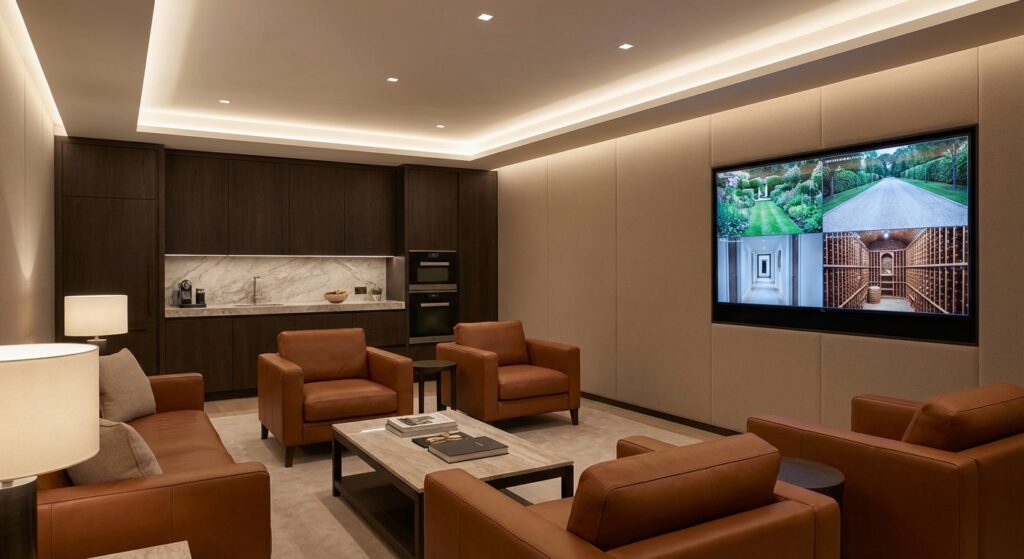
SIRA Inspection Process and Documentation
SIRA conducts three mandatory inspections during safe room installation: a pre-installation documentation review, a rough-in inspection before wall closure, and a final commissioning inspection. Contractors submit as-built drawings, equipment certifications, and test results at each stage. The rough-in inspection verifies electrical rough-ins, structural reinforcement, and equipment mounting provisions before concealment.
Final inspection includes functional testing of all systems under simulated emergency conditions. SIRA inspectors verify power transfer times, biometric authentication accuracy, ventilation flow rates, and communication system connectivity. Equipment requiring annual recertification includes backup generators, battery systems, and fire suppression equipment if installed.
Required Documentation Package
- SIRA contractor license copies for all trades involved
- Equipment certifications and country-of-origin documentation
- Electrical load calculations and circuit protection schedules
- As-built drawings showing final equipment locations and wiring paths
- Commissioning test reports with dated, signed results
- User manuals in English and Arabic for all installed systems
- Maintenance schedules and service provider contact information
- Emergency operating procedures are posted inside the safe room
The certificate of completion remains valid for one year and requires annual renewal inspections. SIRA performs random audits of existing installations, checking maintenance logs and system functionality. Non-compliance findings must be corrected within 30 days, with follow-up inspections verifying remediation.
Cost Factors and Budget Planning
SIRA-compliant safe room installations in Dubai range from AED 150,000 for basic 10-square-meter rooms to AED 800,000 for 40-square-meter installations with advanced features. Equipment costs represent 40-50% of total project budgets, with structural modifications consuming 30-35% and permitting, testing, and certification accounting for the remainder.
| Component | Budget Allocation | Typical Range (AED) |
|---|---|---|
| Structural Work | 30-35% | 45,000-280,000 |
| Security Equipment | 40-50% | 60,000-400,000 |
| Mechanical/Electrical | 15-20% | 22,500-160,000 |
| Permits and Testing | 5-8% | 7,500-64,000 |
| Contingency | 10% | 15,000-80,000 |
Premium features increasing costs include NBC filtration systems (AED 80,000-150,000), satellite communication terminals (AED 40,000-75,000), and integrated medical equipment (AED 25,000-60,000). Installation timelines span 12-16 weeks from permit submission to final SIRA approval, with structural work requiring 6-8 weeks and systems integration consuming the remaining schedule.
Maintenance and Ongoing Compliance
SIRA requires documented quarterly maintenance for all safe room systems, with specific testing protocols for each component. Biometric systems undergo monthly calibration checks and quarterly user database audits. CCTV systems require lens cleaning, verification of storage capacity, and recording quality assessment every 90 days.
Annual comprehensive testing simulates a complete building power failure, verifying generator startup, automatic transfer switch operation, and sustained system functionality throughout the 72-hour design period. Ventilation filters require replacement based on pressure differential monitoring, typically every 6-12 months, depending on ambient air quality. Battery systems require capacity testing every 6 months, with replacement recommended when capacity drops below 80% of the rated capacity.
Service contracts from SIRA-licensed providers ensure compliance with maintenance schedules and provide documentation for annual renewal inspections. Contracts typically cost 8-12% of initial installation value annually, covering preventive maintenance, emergency repairs, and system upgrades as SIRA revises technical standards.